
A specialist machinery manufacturer builds its own computing equipment
How a lack of tools in our own design department led to the creation of a mechanism editor, and what AI can and cannot do in this context.
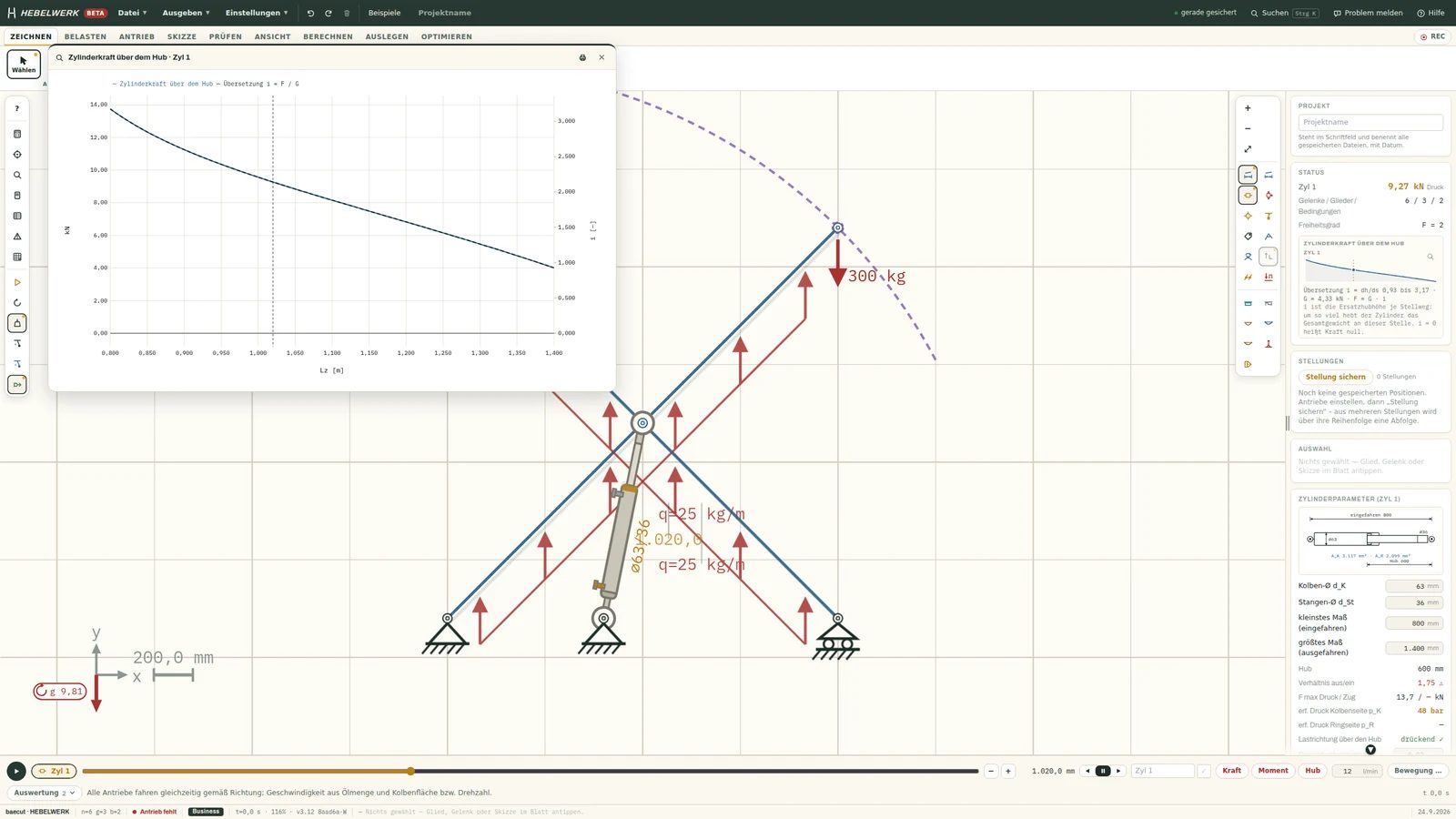
Hebelwerk It was developed in August 2026 because a tool was missing from my own design. I design booms, attachments and harvesting equipment, almost always using hydraulic cylinders on flat articulated chains. There are good programmes for kinematics, for forces too, and for the final verification anyway. But nothing that incorporates all three steps into a single model, so that the forces are derived from the motion, the verifications from the forces, and the report from the verifications, without a single figure having to be typed in manually. So I built it. Not on my own: most of the code comes from an AI, whilst the requirements, testing and responsibility are mine.
This article describes what went well and where the risks lie. The two go hand in hand.
What it’s all about
Hebelwerk is a web application that performs calculations in the browser. You draw links and joints, specify bearings, drives and loads, run the mechanism and obtain bearing forces, internal forces, stresses and the verification results for bolts, welds, screws, buckling and fatigue strength. The result is a report detailing the calculation method, which an inspector can verify. Since the beginning of August, over three hundred versions have been produced, each with a number that also appears in the report.
The workflow is always the same: I describe what the next stage should be capable of, ideally with an example and a manual calculation against which the result is checked. The AI builds the model, checks it against the manual calculation, and delivers a package and a build report. I upload the package, run my own models through it and report anything that isn’t right.
What AI has taken over
The calculation modules. A bolt design check, a fillet weld in accordance with Eurocode, a bolted joint in accordance with VDI 2230, a shaft in accordance with DIN 743, a buckling member in accordance with Euler: these are formulae found in books, and AI applies them faster and with fewer typing errors than I do. It is important that every formula is verified by a manual calculation before it is entered into the programme. These verifications formed the basis of the validation booklet, comprising 25 test examples with target values and tolerances, against which every version is checked.
The test itself. Hebelwerk now has a test suite comprising over two thousand test cases, which runs before every release: Does every example still calculate the same result as yesterday? Does every button have an icon? Does every output carry the approval stamp? Is every command listed in the help section? Writing these test cases is painstaking work, and painstaking work is exactly what an AI does without complaint.
The translation. The interface and the report are available in German and English – that’s over three thousand texts. I could never have done that by hand.
The documentation. Help section, index with 153 entries, construction report for each version. All things that would otherwise be the first to be neglected in a one-man business.
Where she’s getting stuck
Plausibility. In one version, the utilisation was determined by the scale limit of the colour legend rather than by the permissible voltage. The programme ran, the colours appeared, the legend counted correctly, and nothing crashed. However, every component was red, even though it was operating at 77 per cent capacity. No smoke test would pick up on something like that; only a person looking at the screen and knowing what to expect would. This error remained in the programme for two versions because, at the time, I had skipped the testing to make faster progress. The lesson has since been enshrined in the building regulations: no release without testing, even if it takes longer.
The reference to standards. The AI knows the formulae, but not my version of the standard. Whether a coefficient comes from the 2015 or 2023 edition, whether a table for structural steel also applies to cast steel, whether a method calculates ‘in accordance with’ or ‘based on’ a standard: I have to decide this and specify it as such in the report. That is why ‘Hebelwerk’ states on every verification report what it covers and what it does not. A colourful stress diagram looks like an FEM result; it is a nominal stress of the cross-section, without notch effect, and that is exactly what is stated below it.
The test cases. On several occasions, I reported an error that wasn’t actually an error, because my test model had been set up incorrectly: a mass entered twice, a four-bar linkage that did not satisfy the Grashof condition. The AI then dutifully searched for the supposed error. Since then, the rule has been: when an error message appears, check the test case first, then the programme.
Responsibility. A report generated by Hebelwerk bears my name, not that of the AI. The tool makes the calculations transparent; it does not relieve me of the responsibility to check them. I believe this is the right ‘seat’ for AI in mechanical engineering: not as a computer you trust, but as a colleague who works quickly and whom you keep a close eye on.
Results and limitations
After six weeks, a tool has been developed that you could never have bought, and it is now in daily use. Its limitations are the same as those of any software: it calculates what you tell it to, based on the assumptions you make. Anyone wishing to try out Hebelwerk can find it at editor.baecut.de, free of charge. The test examples are included in the validation booklet.